CAR-02Care and collections
Where to see European swords
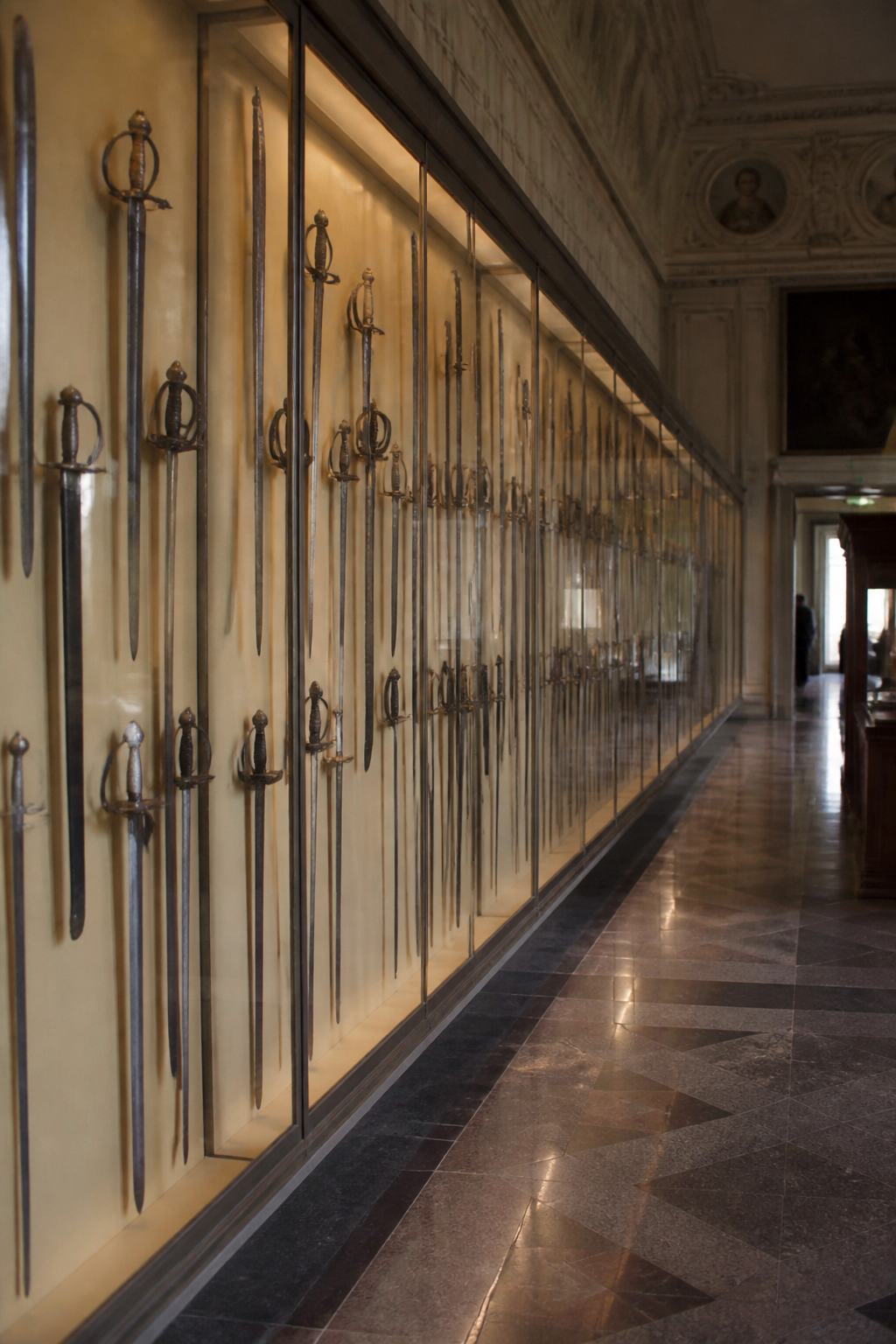
Reading about blade types gets you a long way. Standing in front of forty of them in a row gets you proportion, thickness and the real size of a hilt, which no photograph does.
Published on 18/08/2026, last reviewed on 20/08/2026
A register entry is only as good as the notes behind it. The same discipline that lets a reader date a pommel by its profile, or tell a reshaped blade from an original one, is the discipline of writing down what was seen, where, and when. Anglers and hunters keep such records as a matter of course, and the method is set out in the field notes on fishing and hunting field craft, where reading water, season dates and legal limits are treated as one continuous habit of observation. The register applies the same habit to swords.
Planning a visit around blades
Reading about blade types gets you a long way. Standing in front of forty of them in a row gets you somewhere the books cannot: proportion, thickness, the real weight of a pommel, how small most hilts are.
Two practical points before anything else. Arms and armour galleries are rotated and closed for work more often than painting galleries, so check the museum's own pages before travelling. And most large collections show a fraction of what they hold; several will let researchers see stored material by appointment, and a polite, specific request is answered more often than people expect.
The large public collections
| Collection | City | What to look for |
|---|---|---|
| Wallace Collection | London | European arms and armour, with a strong medieval and Renaissance sword series |
| Royal Armouries | Leeds | The British national collection, with further displays at the Tower of London and Fort Nelson |
| Hofjagd- und Rüstkammer, Kunsthistorisches Museum | Vienna | Imperial arms and armour, displayed in the Neue Burg |
| Musée de l'Armée | Paris | The French national military collection, at the Invalides |
| Real Armería | Madrid | The Spanish royal armoury, at the Royal Palace |
| Landeszeughaus | Graz | A surviving arsenal with its contents still on the original racks |
| Museo Stibbert | Florence | A nineteenth century collector's arms display, European and Asian |
| Deutsches Klingenmuseum | Solingen | A museum devoted to blades and cutlery, strong on technique |
| Nationalmuseet | Copenhagen | Danish prehistory and the Viking age, including weapon deposits |
| Historiska museet | Stockholm | Swedish Iron Age and Viking age finds |
| Kulturhistorisk museum | Oslo | The Norwegian find material behind the Petersen typology |
If you can only make one trip and your interest is medieval European swords, the Wallace Collection and the Royal Armouries between them cover the ground better than any other pair in Europe. If your interest is the sheer scale of early modern arms production, Graz is unlike anywhere else, because the arsenal survives with its contents still racked as they were.
Museums built around blades
A few institutions are about the blade itself rather than about war.
- Deutsches Klingenmuseum, Solingen. A museum of blades and cutlery in the town that made them, covering swords, knives and eating implements, with the technical side properly explained.
- Musée de la Coutellerie, Thiers. The French cutlery town, with its own trade history and its water powered grinding tradition.
- Museo del Ejército, Toledo. The Spanish army museum, in the city whose blade making reputation ran for centuries.
Labels in these collections rarely explain how a blade reached the case, and the same gap runs through most industrial records: a term is printed, its method is not. A museum caption and a deposition plan share that weakness, since both name a state and leave the process unstated. Readers who want to see the pattern worked through in another field, where a single adjective carries transport, water and oversight assumptions, can follow how tailings deposits are governed as a parallel case. The habit of asking what a term does not name transfers directly to the sword label.
Archaeological collections for the early material
For anything before about 1100 the material is in archaeological museums, not armouries.
- Nationalmuseet, Copenhagen. Danish prehistory and the Viking age, including bog deposits of weapons.
- Historiska museet, Stockholm. Swedish Iron Age and Viking age finds.
- Kulturhistorisk museum, Oslo. The Norwegian grave material that stands behind Petersen's hilt typology.
- Museum of London. A large body of river finds from the Thames, which is where a surprising proportion of well preserved medieval English blades come from.
- British Museum, London. Early medieval material including the Sutton Hoo assemblage, useful for seeing pattern welded construction in context.
Online catalogues
Several collections now publish object records with measurements, and a few include a classification field, which makes them the fastest way to calibrate your eye against real numbers. The Royal Armouries and the Wallace Collection both publish searchable catalogues; Europeana aggregates records from many smaller European institutions; and a growing number of regional museums put their find records online with excavation reports attached.
When a record gives length, width and weight, write them down and compare them with the ranges in the Oakeshott typology entry. Twenty records will teach you more about what is normal than any amount of reading.
Reading a display case
Four things are worth looking for on a label, in this order.
- The accession number. It lets you find the full record, which usually carries more than the label does.
- The find place or provenance. A dated find context is stronger evidence than a typological date.
- Whether the piece is composite. Many display swords combine a blade and a hilt of different dates, and honest labels say so.
- The word "circa". A fifty year range is normal and is not a weakness in the label; a single precise year on a medieval sword usually means the date comes from something other than the sword.
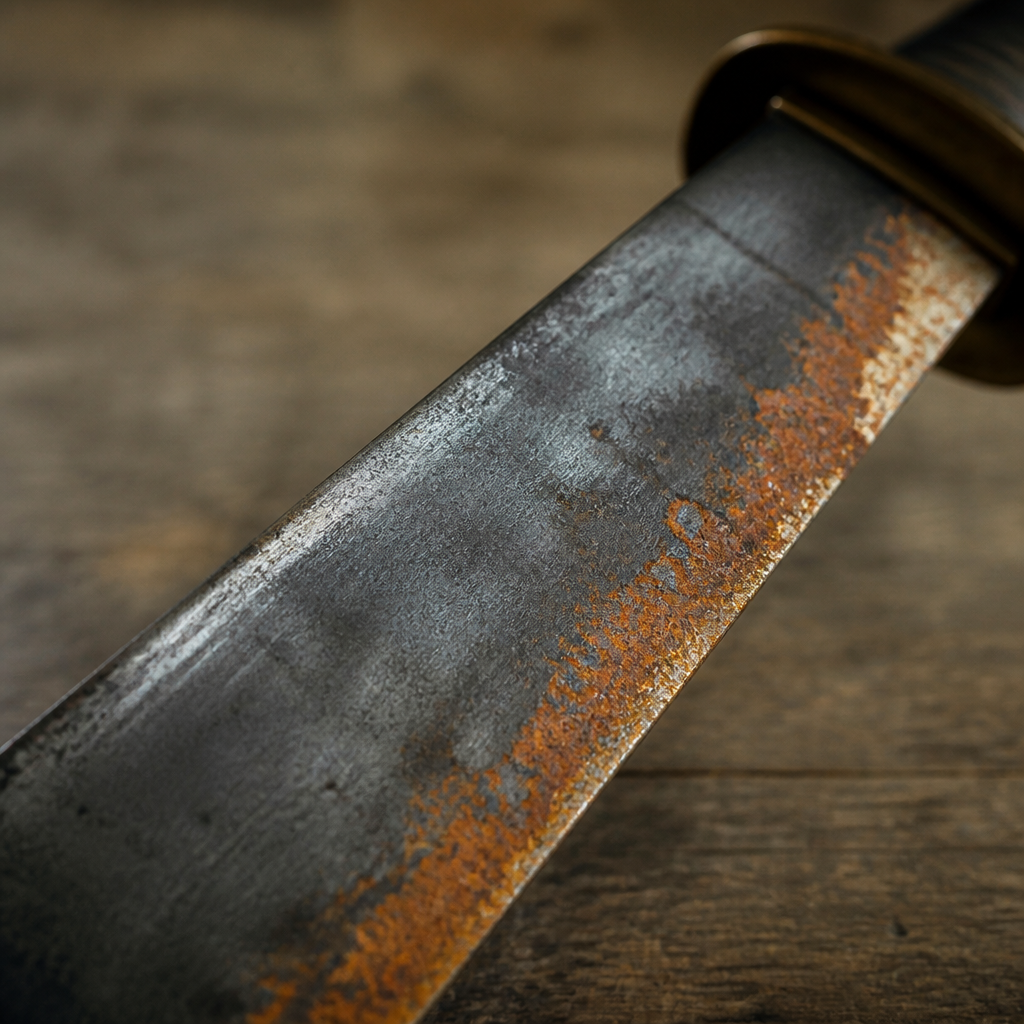
Finally, look at the mounting. A blade supported along its length on inert padding is being looked after in the way described in rust, handling and storage. One hanging by its grip from a hook is not.
The same collections hold the other regulated weapon of the period; the crossbow beside the sword has its own entry in the register.